

The question isn't should you be using AI in your recruiting, it's HOW should you be using it.
AI is quickly becoming part of the recruiting conversation — but not everyone is comfortable with it.
In this episode we’ll discuss what drivers actually think about AI, where automation can help recruiting, and where human interaction still matters most.
From communication and trust to over-automation and driver expectations, the conversation explores the growing tension between efficiency and authenticity in modern recruiting.
Download Your Copy of the Data Featured in Today's Episode
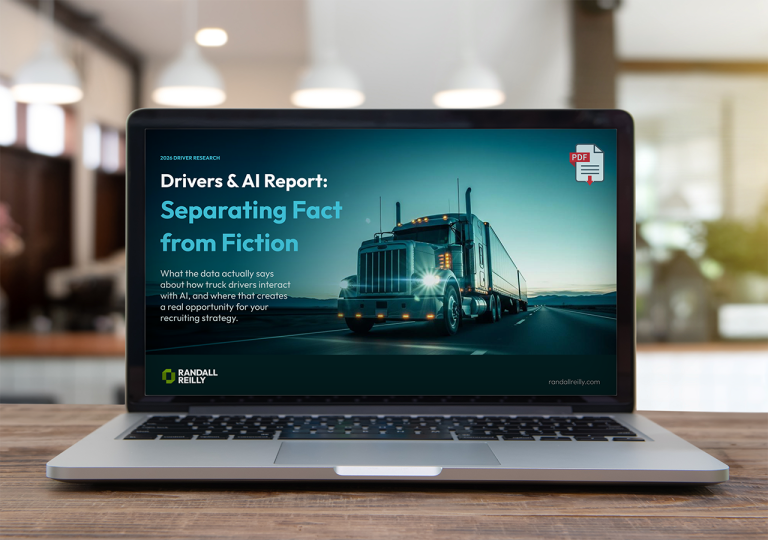
AI is suddenly everywhere in driver recruiting conversations, and from the sounds of things you would think drivers are already using it for everything.
This report looks at how drivers really interact with AI, what they say about it in search and hiring, and what that means for how fleets should (and should not) use AI in recruiting.
All of the data discussed in today’s episode is available in the Drivers & AI Report: Separating Fact from Fiction.
Want to be Part of Our Next Digging Deeper Live Discussion?
Don’t miss your opportunity to share your thoughts and help steer the chat. Digging Deeper is back every month with a new topic. Dave and his panel will discuss the issues and field any questions our viewers may have. If you want to join us and become part of the discussion you can sign up to be notified when the registration for our next Digging Deeper opens up.
We look forward to you joining and playing an active role in the show!
Learn More About Stratas® Agent
Full Episode Transcript
AI in recruiting truck drivers. What's good, what's bad? What are fleets getting right and what are fleets getting completely wrong? Do drivers want anything to do with it?
Will it completely change the recruiting process? And what do drivers actually think? Because drivers are already interacting with AI in other parts of their lives in our research. 42% of drivers said they immediately scroll past Google's AI overview results, but 35% said they read at least some of the AI generated response before moving on, and another 18% said they stay in AI mode and continue engaging with it.
So whether people realize it or not, drivers are already building habits around AI driven experiences. But what does that mean for recruiting? Does AI make the process faster and easier? Does it make it feel less personal?
Are there certain parts of recruiting where drivers are perfectly comfortable with automation, and other parts where they still strongly prefer human interaction? And beyond that, what does good AI even look like in recruiting? Is it communication? Scheduling information gathering something else entirely?
We looked into it not just the technology, but the bigger shift happening around communication expectations and the recruiting experience overall. So let's get into it.
All right. Welcome back to Digging Deeper live edition. The chat is open.
We have kind of changed for everyone new. We've kind of changed how we do this. We used to kind of pre-record them and then we would have our little prerecorded conversation between the three of us, and then there would be room for questions at the end. And then the questions were all 100% anonymous.
We've decided to do these more live and engaging. So 100% live now, and we keep the live chat open for you guys the entire time, so feel free to put in your opinions. If you think something I say is wrong or Aaron or Kyle, feel free to boo or hiss or tell us where we think we're wrong. We just want to be as engaging and have a conversation here as much as possible.
And the topic today really is somewhat in its infancy: how much are truck drivers using AI? How do they feel about AI within the recruiting process? Should we be investing in GIO? Where does AI fit?
Should it be more of an outbound thing? Should it be more of an inbound thing? We're going to talk about all of it. You guys have the power to direct the conversation.
Feel free to say anything you want. Also, throughout the time we will be running some live polls, so feel free to participate in those so that we can see how the entire audience is feeling and thinking.
And then one last thing. A lot of what we are talking about, you can see I have it printed out. We are talking about this little piece of research that we just put out, where we surveyed drivers and asked them how they felt about AI so that we weren't just guessing.
We will post a link to that throughout. Josh, off stage over here — if you're a Joe Rogan fan — he's my Jamie. He will put the link up from time to time. Feel free to go to that landing page and download the new report.
It looks like we already have someone in the chat. Oh, somebody asked, “How do I know this isn't AI?” Well, if it is, they really did a good job of modeling me and training me because this is me.
Someone just said hi to Aaron. Aaron is real. And Kyle is real too.
All right, let's get going.
I'm going to go ahead and launch my first poll here. I think the first thing we want to talk about is how much do you think drivers are using AI? Is it a big part of their life? Is there just a small group of power users? What do you guys think?
Before the research came out, I would not have guessed truck drivers engaged with AI very much at all. I would have said maybe low single digits even in 2026.
The thing that surprised me the most was that 42% of drivers say they immediately scroll past AI generated results in Google, because I have found those so helpful.
Did that surprise you? That 42% scroll past that?
Yeah, I didn’t think that either. I almost felt like that number was low because I’m like you — I’ll expand the AI result, but then I’m probably going to keep going through regular search results too.
For me, when I search for something, I'm naturally going to review different web results as opposed to fully trusting that handy little paragraph at the top.
But the first thing I thought when I saw the stat was: 58% do read it. More than half are at least looking at it now.
I feel like I'm pretty tech savvy and forward thinking. I’m always looking for new innovative things. I love Google. I feel like Google is much more robust than some of the Apple products.
Even yesterday I was talking to one of our sales reps and a client was asking for help on one of their advertising pieces. He copied and pasted the ad into AI and simply asked, “Is this competitive?”
It immediately spit out all kinds of useful information.
So it doesn’t surprise me that we’re so early on that sometimes you still have to remind yourself to actually use AI tools.
I feel like in the future being able to show up within AI results is going to become huge. That function of how people search and find things will become massive.
If you think back years ago, there weren’t even paid ads at the top of Google. Then there were three. Then four. Then ads at the bottom.
Google is always evolving around user experience and revenue.
And now we’re moving toward AI-generated search experiences where users may no longer need to visit three or four different websites to find information.
The traditional Google search experience is changing, and it’s going to become even more AI influenced as time goes on.
One thing about this AI data is that it’s probably going to age very quickly.
47% say they’ve never used an AI tool. 53% have used at least one. But only around 10% would qualify as real power users.
One important thing to remember is that the median age of truck drivers skews older than the overall workforce, so adoption is naturally going to lag a little bit behind.
Miller in the chat pointed out that it’s interesting how many drivers have still never even heard of some of the major AI platforms.
35% say they would never use ChatGPT. 29% had never heard of ChatGPT. 34% had never heard of Gemini. 65% had never heard of Grok. 68% had never heard of Claude.
That honestly doesn’t surprise me that much.
One audience member asked whether drivers are using Siri or voice assistants, since those use AI too. That’s a really good point.
AI is already embedded into almost everything people use. Drivers may be skeptical of “AI” specifically, but that doesn’t mean they aren’t already interacting with it constantly.
And that’s kind of the crux of this discussion. AI should be a huge component of recruiting moving forward — but how you apply it matters.
We launched another poll asking whether AI is already a big part of recruiting.
If you’ve been in trucking long enough, you remember what recruiting was like before digital solutions. Then the internet came along. Then mobile phones. Now every driver has a smartphone.
I think AI is the next major evolution of technology within recruiting and trucking.
We’re probably going to see adoption happen even faster than smartphones or internet recruiting did.
We asked Aaron what ways fleets are currently using AI effectively.
Some fleets are using AI for creative work like photos and video. Some are using it for orientation follow-up and keeping communication flowing after scheduling.
Others are using AI for fuel optimization, route planning, and load planning.
But the biggest use case right now is inbound phone calls.
AI can answer calls nights and weekends, handle transfers and rollover calls, and keep opportunities from being missed.
The most impressive thing about AI is that it helps eliminate busy work.
Things like orientation follow-up and repetitive communication tasks are important, but they’re time consuming. AI can help recruiters stay engaged with drivers without tying up the recruiting staff all day.
One of the biggest ways AI has helped our business is data analysis.
There are so many spreadsheets, budgets, and ratios floating around. AI tools can analyze that information almost instantly and help speed up decision-making.
It’s not perfect — you still need to verify the information — but it dramatically speeds up the process.
We also discussed using AI to evaluate landing pages, messaging, and recruiting creative.
Once upon a time you had to manually create endless copy variations and testing structures. Now you can ask AI to generate alternative messaging and rapidly test different approaches.
We checked the poll again and saw that 38% said AI is becoming a big part of recruiting, 23% said they are using AI a little, and 38% said they are not really using AI at all yet.
That honestly doesn’t surprise me.
We also discussed AI-generated video. 53% of drivers said they hate AI videos and immediately skip them. Another 23% said they don’t mind them as long as they aren’t obvious.
Which is funny because if they didn’t notice it, then it probably worked.
We also had a driver quote saying: “I watched the Terminator movies, so I don’t trust AI at all.”
That fear and skepticism is very real for a lot of people.
Eventually the discussion shifted toward practical recruiting applications.
What should fleets actually be doing with AI?
One major area is GIO or GEO — AI optimization for search results.
It’s basically the AI-era version of SEO.
We don’t think fleets need to panic and massively invest in GIO yet, but they absolutely should begin understanding it and preparing for where search is heading.
The way people search for information is going to continue changing rapidly.
One audience member made a great point that while drivers may not be searching for jobs using AI yet, customers and shippers may already be using AI-generated results to evaluate fleets.
That means showing up correctly in AI-driven search results will matter outside recruiting too.
We also talked about what drivers actually want from AI.
The goal shouldn’t be to make drivers excited about AI itself. The goal is to make their lives easier.
If a driver calls and reaches voicemail, that’s frustrating. But if AI answers the call, gathers information, schedules follow-up, and provides answers immediately, that creates a much better experience.
That’s where the real value is.
The key opportunity is capturing high-intent moments.
If a driver is calling your fleet, their intent level is incredibly high. Missing those calls is leaving opportunity on the table.
We discussed how tools like Stratas® Agent are helping fleets capture those opportunities by answering inbound calls, collecting information, and routing qualified leads appropriately.
One client discovered that nearly 50% of their inbound recruiting calls were just simple questions.
AI handled those questions automatically, which freed up recruiters to spend more time actually recruiting.
We also discussed why inbound AI currently matters more than outbound AI.
If a driver calls you directly, their interest level is much higher than someone receiving a cold outbound AI call months later.
That’s why we focused on inbound opportunity first.
We also shared some adoption data from Stratas® Agent itself.
In the early rollout months, the system handled around 2,200 calls. Recently it handled over 16,000 calls in a single month.
And importantly, the average call duration remained strong — around two minutes per call — showing that drivers were actively engaging with the experience.
That’s significant because it demonstrates that drivers may say they dislike AI, but if it helps them accomplish what they need, they will absolutely use it.
One major takeaway from the discussion was that adoption is happening, even among older drivers.
We aren’t yet at the point where large numbers of drivers are job-searching through ChatGPT, but that shift is probably coming eventually.
Right now the biggest opportunity is using AI to make recruiting teams more efficient.
That includes optimizing creative, analyzing recruiting performance, improving communication, handling repetitive tasks, and capturing high-intent inbound calls.
If you’re sitting in a boardroom and someone asks, “What are we doing with AI?” those are probably the areas worth focusing on right now.
At the end of the day, AI is not about replacing recruiters.
It’s about making recruiting teams faster, more efficient, and more responsive while still preserving trust and human interaction where it matters most.
And finally, we encouraged everyone to simply start experimenting with tools like ChatGPT or Gemini.
Ask questions. Upload spreadsheets. Test ideas. Explore workflows.
Because whether people are ready or not, AI is coming — and the fleets that learn how to use it effectively are going to gain an advantage.
We appreciate everybody for joining the discussion and participating in the live chat. Thank you for showing up, and we’ll see you next time on Digging Deeper.