

When "That's the Way We've Always Done It" Costs You Drivers
What happens when bad recruiting habits become business as usual?
In this episode of Digging Deeper, we explore how everyday processes can quietly hurt hiring results. Learn how to identify recruiting blind spots, challenge the status quo, and build a hiring process that actually works.
Join Dave and his guest, Aaron Mowery, as they discuss the 7 Deadly Sins of Driver Recruiting.
Get the Full Download Revealing the 7 Deadly Sins of Driver Recruiting
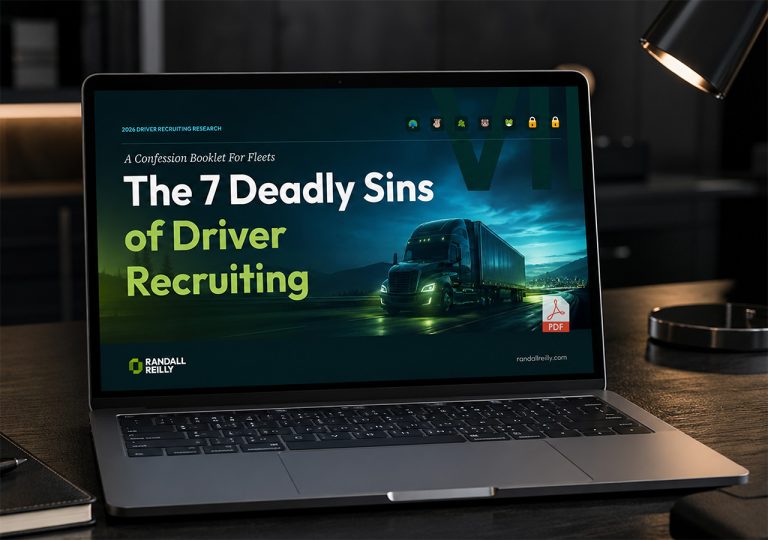
What’s inside?
- How fleets are wasting as much as $144k per year
- What makes 76% of drivers walk after one bad call
- Why nearly 43% of drivers now rank reputation above pay
- And much more …
Never Miss a Digging Deeper Discussion
Don’t miss your opportunity to share your thoughts and help steer the chat. Digging Deeper is back every month with a new topic. Dave and his panel will discuss the issues and field any questions our viewers may have. If you want to join us and become part of the discussion you can sign up to be notified when the registration for our next Digging Deeper opens up.
We look forward to you joining and playing an active role in the show!
Full Episode Transcript
At Randall Reilly. We've been helping fleets recruit drivers for decades. Now, over the years, we've seen the same recruiting mistakes cost fleets good drivers again and again. They're usually not dramatic. They're small breakdowns that quietly hurt recruiting performance every day. We call them the seven deadly sins of driver recruiting. Today I'll walk through the first five. Now the first sentence pride.
Too many fleets assume their reputation speaks for itself. But today's drivers are talking to other drivers long before they ever talk to your recruiter. If you aren't actively managing your reputation, someone else is doing it for you. Now the second sin a sloth. Speed matters more than ever. Drivers are often talking to 6 to 8 fleets at the same time, and the first fleet to respond usually wins the opportunity.
Recruiting has become a race, and slow follow up is costing fleets drivers every day. Now the third sin is envy. Everyone is chasing the latest AI trend, but many fleets are solving the wrong problem. AI certainly has a place, but not if you're ignoring the fundamentals that drivers actually care about. Now the four sin has wrath. One bad recruiting call can in the relationship before it ever begins.
A missed call, long hold or frustrating experience is often all it takes for a driver to move on to the next fleet. Now the fifth sin. That's greed. Overselling the job may help you get a yes today, but when orientation doesn't match the promise you've already lost, the driver. Trust is one of the hardest things to earn back.
The final 2nd May actually be the most costly. Will impact the research behind them. Explain why they're becoming bigger problems for fleets every year, and show you what the best recruiting teams are doing differently.
Hi everybody. Welcome to Digging Deeper. Boy, do I hate watching myself to start these things. Today I have with me my trusty sidekick, Aaron Mowery. If this is your first time to digging deeper, I always try not to complete the fight club line when I start with that way. This is your first time at digging deeper.
We've been doing things a little bit differently lately. We've been doing all of these live. We are looking at research that we've put out this year and we have the the chat, the live chat. I'm going to go and head and tell everybody, hello. We want to encourage everybody to participate in the live chat as much as possible, be a part of what we're talking about.
If you have something to say, please tell us all your thoughts. If you think something we say is wrong, tell us. If you think something we say is right, tell us. If you have a question, use the live chat. Now. The live chat is not anonymous, so if you do have an anonymous question that you are a little bashful about, feel free to use the Q&A.
I think that's it. Am I miss anything? All right, so let's go ahead and jump into it. We're talking about the seven deadly sins, and we try to keep these things to around 30 minutes. If you guys have lots of questions we want to talk. We'll go longer. But try to keep these things to about 30 minutes. So we're going to jump through these pretty quick and make sure we leave plenty of time at the end to talk about the final deadly sins.
All right. Let's go into the first one. The first one is pride, which we're going to dispense with the metaphor pretty quickly and just stop, start talking about the actual how it relates to fleets. But the first one is basically the idea that, I think a lot of fleets and you can tell me if you think this is a correct assumption, I think a lot of fleets assume their reputation, and there's a particular line in this download that I thought was pretty interesting.
It says your reputation is built, is your reputation is built or broken in conversation. You've never actually you're never actually a part of. And the idea is that most people build their opinion of fleets by talking to other drivers. What would you have to say about that? I mean, I think it's a true statement. I have a question, by the way.
This just came out last week. Correct. Have they seen it yet or they get it afterwards? No, they have all seen it. Now we'll add Josh, if you want to add the full unredacted version, the full download without the last two redacted are available. If you hit that, get the full download button in the top right corner. But they have seen this unless they haven't downloaded and just registered, but okay.
If not, go ahead and download it real quick. I mean, I think yes, absolutely. Word of mouth is huge. I do think that the I've had executives say before, it's different than many companies. Trucking is different. They have a billboard rolling down the road 24 over seven, in some cases 9000 billboards rolling down the road. I don't want to say that the reputation and obviously the driver interaction and talking to them in the truck stops matters or CB radios or at the DCS while they're sitting there waiting, but their trucks too.
I know a lot of companies that pay big money to make sure that those trucks are run through the car, wash the truck wash, clean, nice. There's something appealing about that for a driver who spends, you know, 80% of their working hours inside that vehicle. So, again, driver reputation or fleet reputation isn't just about the driver. I do think it is a yeah reflection of that vehicle.
Yeah. And I would say it even goes on to like what your first interaction look like when you call up. And you know, how easy is your recruiting process. What is the orientation like? All those things contribute to your to your I mean, there's that stat that we got from a couple of years ago, and it may be in here that the idea that, you know, 83% of drivers have said they knew they were not going to stay at a fleet just based off of orientation.
So I think the idea is that they're constantly building an opinion of you. Now, I'm going to make a bold step. I was going to make a bold statement, but I, I instead instead decided to phrase it in the form of a question. Do you think fleet your reputation as a fleet is your biggest asset for recruiting?
So selfishly, from an advertising perspective, we can run the same channels. Yeah, same bid strategy using, you know, keyword data or job creation data historically with different fleets. And they perform wildly different. And a lot of it, the majority of it is the reputation. So again, selfishly, there is something to be said about certain fleets. I was on a call right before this with a fleet that has 35% turnover.
Their campaign is going to produce exponentially better than, you know, some of the fleets that have a 150% turnover. Keep talking. I'm going to put a poll up to see what the audience thinks. I don't have anything else to say. All right. Well, let's answer your question. It is a huge factor. All right. I have a lot of opinions about this next one, but our next deadly sin is basically speed.
And like how quickly you're able to follow up with leads, how quickly you move people through the process. I think you could add in the idea of just how much friction is in there. Do demand a full app is do you have lots of different ways in which drivers can express interest? How important do you think, especially now that we see tightening of capacity, we have some questions up that we need to look at real quick with, with capacity tightening, how important is speed to lead?
I try to be empathetic here. In the last three years, speed was not as important. And so they did that on purpose. They added friction to the hiring process. Maybe they didn't need inbound phone calls as much. They maybe they layered their short form was ten questions instead of 3 or 4. And moving slower as a recruiting department, I think sometimes is necessitated.
It's on purpose. So they're trying to find the ones that matter most or the best candidates. So since about March, I have definitely seen that change. And the the teams that have been slow to react to that change are the ones that are screaming right now. So to answer your question, yes, it is very important. It just wasn't as important.
Right. That makes sense. And I think a lot of things with we've talked about this a lot at the market does dictate priorities for fleets big time obviously. I mean it's not a grand revelation, but it's there is some interesting stuff in the nuances, you know, of how that operates now, I will say. So we have a question in the Q&A it says, what was the percentage of people leave based off of orientation?
The it's 83% have said they were going to leave, 83% have said they were going to leave just based off of orientation. They just knew and I saw it in here. So yeah, I think it is actually in here. And the idea is just the sense they got from how orientation operated. I think it's on the seventh Deadly Sin.
It is in here. Yeah. That the feeling they got from orientation, they just knew this was not a long term fleet. What do you think about this? My biggest issue is speed to get drivers qualified. Where are we now? We are now. This is from the audience chat. Lisa. Oh, I'm sorry. Said my biggest issue is speed to get drivers qualified.
What do you think about that? Yeah, I think it goes back to you mentioned in your promo and maybe in here somewhere, but 6 to 8 fleets at a time you're looking at. So again just had a call earlier with a client 30% turnover. They do not take inbound phone calls. Right. They only work full applications. So some of their frictions on purpose.
And and you're going to lose drivers that way. And they're somewhat okay with that that we know that they're looking at 5 or 6 6 to 8 options. And we're we're only going to look at the best. But yeah, to get them qualified a driver is especially a good one is driving during the day. So there's some of that is difficult just getting the recruiter or the the processing team connected with the driver when the drivers available or when recruiting is available.
I don't have a great answer to that. Staggering your hours, working after hours, scheduling specific times for follow up, handling as much of it on the initial call as possible. We've got some clients that that first initial call may be 40 or 45 minutes. They'll do it all. They'll yeah, they'll get the app. They'll start the process.
They'll get a driver to sign that while he's on the phone with them. So I guess that I was going to ask you for advice on how to qualify drivers faster. And one of it, one of them would be if you can do it on the phone, go ahead and do it on the phone. You obviously got to get their approval, right?
Yeah. And then the flip side is just take a look at your own process. There are times where safety, I think is too involved. And recruiting will be waiting three, 4 or 5 days to hear back from safety when if you benchmark off of some of your other peers, that's not what they're doing. So again, you can't completely change who you are.
But if you're waiting for five days for safety to get back to you. There is definitely some room for improvement. Lisa had a follow up. She said safety at my company is the biggest hurdle. I can process the application fast. It's just a safety part. Yeah, yeah. And I maybe a benchmarking group we can get you connected with or to look or talk to some some other fleets and how they do it.
I'm happy to do that. I again, selfishly, from the advertising side, we see the same thing. If a client, when we're looking at potentially bringing on a new client and finding out how safety plays a part in recruiting, we try to set the expectations at the beginning. Hey, this is going to go as smoothly and and quickly as safety.
Your your biggest bottleneck. So anyway, happy to help there. But that that is a big one. Well, someone that adds to that. Someone asked the question in the Q&A. What's the national average for qualifying drivers if you have this info, is the question specifically days? I'm not sure. Maybe you can clarify if you ask that question, but maybe answer it is she's asking like days.
So if that's leads. Yes. Days. Okay. Gosh, I would have to get some better data. There are quite a few fleets who train their recruiters to know their what they're looking for to, to, you know, maybe you have different levels of recruiters, but they know the requirements and it's in the recruiters hand, not safeties. So only I think it's less than 10% of those applications get pushed to safety for review that maybe are on the line.
That absolutely will speed things up versus safety handling all of them. Okay, I don't know the answer, but I know that people are approving and qualifying in 2 to 3 days. You know, driver comes in on Wednesday and they get them in orientation the next Monday. Right. Anyway I don't know for sure. Right. Okay. That makes sense.
Now I wonder we've talked I remember we've talked in the past about just conditional. No. Like what's the what's the life cycle of the lead from like the time the lead is submitted to the actual hire. Right. That's about 25 days. 25 days. Yeah. But which is different than qualifying. But I was trying to put some more time, you know, I get some framework around it.
All right. Let's move on to. I got one more though I would say the driver some recruiters, you can do a conditional offer and they'll go ahead and schedule them for orientation before all that's done. Again, that is dependent on each fleet. But okay, if we didn't answer your question very well, let us know. We'll try and find a better answer to that specific question.
I know we had some unknowns there, but we're always running research and that's something you guys feel free. Just to add to the chat, we do research and surveys almost every month. Our marketing team does. So if you have specific data that you need, which we haven't done a real fleet benchmarking study in a while, we're doing one currently on AI, but did get kind of a, I think just a benchmarking on some of that stuff.
We need to update some of that. So that'd be a good idea. All right. Moving on to the deadly sin number three. And this is all about envy or the idea of chasing after things just because they're shiny. And this came specifically from research we did with that last month or two months ago. Two months ago we surveyed a lot, I think about 3400 drivers on their AI usage.
And one thing that we did discover is give or, you know, generative engine optimization and the idea of like showing up in AI results, that's not yet it will be, but it's not yet a huge component of how drivers look and compare. Look at fleets and compare fleets and research jobs so we can spend a long time on this.
But I think the big idea here is don't just get technology because it's new and and fun. Make sure there's actually a use case for making the driver's life better and actually a revenue case for additional hires. Obviously, this is a little bit self-serving, but the biggest area where we've seen where AI has made a big difference is just fielding inbound phone calls and creating more efficiencies, and how quickly drivers can submit their info so that speed to lead is really the biggest area of improvement that AI is playing currently, I feel.
Yeah, great. Yeah, I agree, I you just got to be what's the word wise or ask a lot of questions because I think a lot of vendors are throwing out AI on the front end of everything they do, and there's really nothing special about it. Right? Yeah, I agree, I agree. All right. Deadly sin number four. We're moving through fast.
We did have one question here in the chat. It says if you were late to change with the market like we were talking about, kind of talking about how what is important changes, what can you do to catch up quickly. You know, well, one of be working with a really good partner because they're, you know, because they're talking to a lot of fleets.
They're going to have insights that may be a bit of a blind spot to you. The other would be understand what's important in the market that you're dealing with. I think it's you know, I can remember when and, you know, the post-pandemic market where it's like it's all about, you know, lead to hire is by far the most important metric, right?
Cost per lead almost becomes irrelevant. And so it's little things like that of understanding what is the metric that is actually the lead measure to your goal of what you're trying to accomplish. So I would say do you have anything you would add there? Yeah, I would ask hopefully they're a client of ours. If if they are, I would ask them to reach out to myself or their, their team and see if we can do kind of a consultation.
Just take a look at some benchmark stuff. Yeah for sure. One quick one would be obviously is your pay a line. That's an easy one. We can help there. Maybe you already know that piece, but there are definitely other things that I think don't get noticed. And we can help maybe surface one of them again. This is from just today, but a client the majority of their fleet or Peterbilt five seven, nine great vehicles and on truckers news right now we're running a poll which I think it has about 300 respondents so far to the driver, what equipment do you like best?
If I remember correctly, the last time I looked at it, by far the Peterbilt ranked the highest. We need to check that. Check that the example is this fleet the majority or this this company, their fleet, the majority of their fleet was the Peterbilt, but nowhere in their advertising were they even mentioning it. That's a quick win. So there's probably a few of those for each of our clients that we can just do a quick consultation.
Let's dig into and see. I'm assuming the comment was, hey, if we were a little behind, I took that as maybe we didn't increase our pay as quickly as we should have. But there are other things that we can help get out there fast. That should give you a little bit of a competitive advantage. We have another question, a anonymous question.
It says back to reputation. How can I know what my organization's reputation among drivers is? I mean, can you answer that better than me? MPs score. Can they do something? So it's kind of it's. Yes. So there's there are internal surveys. So you kind of want to get a gauge of how your drivers think about you. And there are I don't think the one that I'm thinking of is still around or they got bought up or count or stay metrics.
Yeah. There's several there's several. Yeah. Companies that offer internal survey service that would be current drivers. That's current drivers in the market. There's several things you can look at search search data and keyword search keyword search and see how that's trending over time. I would say to if again, if you you don't have to be a client of ours, but if we can get some details on that fleet flatbed thousand trucks, you know, whatever requirements, we can also benchmark off of another 25 or 30 of our clients and just show some data on cost per lead.
That is a big indicator that says, hey, the same channels for this company takes me $100 to get a lead for this company. I can get a lead for $30, right? That does have. Yes, that'd be great. Is compared cross comparison from, you know, similar fleets and then what it costs to bring in a driver. And then some of it is another kind of easy one is just being active on reviews, looking at like Glassdoor reviews, looking at indeed reviews.
You can get a little I mean that's going to skew. Generally people are way more likely to leave negative reviews. So one negative review doesn't necessarily mean something. But if you can compile like this thing keeps popping up, it kind of gives you a little bit more indication. And then I will say, oh, look at that as the team seeing that.
Or are we just seeing that's just us. They pulled up the driver or the truckers news survey. Oh appreciate it. Look at that I will say. So it was it was 35% on the Peterbilt five, seven, nine. The one one area that you talked about MPs and I've brought this up before, but we did a study a couple of years ago where we looked at referral and rehire rate and specifically, you know, we looked at both, but then with referral rate, we tried to correlate it to the size of your referral bonus.
And within like if you were in that kind of normal range, I think there was probably a tipping point where it's like if you offered a $20,000 referral bonus, you'd probably get some, but the how far above or below you, above or below you are on the average of referral rate is somewhat of an indicator of how much fleets or or drivers are willing to recommend recommend your fleet to other drivers.
So that was a mouthful, but the idea is your referral and rehire rate are a little bit of an indicator of your reputation. I would, yes, I agree, but I also think sometimes the C-suite disconnected there and they do not offer a good enough for referral. Right? Right, right. Hey, one other thing on Reddit. No swearing. I was going to ask about Reddit.
Okay, I don't know if I'm in there and there's a couple different trucker if you call it a subreddit when you're subscribed and Reddit. Is that what it's called? Well, I'm, I'm subscribed to a couple of different trucker forums or subreddits. I would I've never done it. So this is completely off the cuff. But if you have jump on, jump in Reddit and just ask in that trucker Reddit, hey, what do you think about this company, your own company, and just see what you get back?
I read them all the time I was. I was in there today reading about Tarp pay and what drivers are expecting for Tarp pay, what they get for Tarp. They have another question in the audience chat. David Jingo, hopefully I said your last name right. I'll just go David my name to what is a good average referral bonus?
It's it's going to be dependent on the fleet. If I had some cost per hire information, that would help. But somewhere around $2,000, 2000 $503,000. But just without knowing anything, $2,000 is safe. I see a lot of folks that it's $500. And then I, you know, I also see some other ones that are on the other side of that.
That's five grand for every driver they refer. So we can help dig into specifics, but $2,000 is a good kind of baseline. All right. Let's see. All right, moving on to number four, which is the idea. It's called wrath. Whatever. But the the idea there is how important that first interaction or the first phone call with the driver is.
Obviously when a driver calls in, that's his highest intent moment. I don't know if do we have the stat in here of what percentage of drivers, if they're interested in your fleet, their first move is to call. Can you get on that stat? But it's a majority, the majority of drivers that the biggest cohort of drivers, when they're interested they call.
And as we said, they're talking to 6 to 8 fleets at one time. You really need to capture that high intent moment, make it very impactful for the driver. Make sure you're interested. You know, I don't want to get into it at all. But I mean, we've talked a million times about how recruiters should interact with drivers and, you know, understand, you know, the reason that they're calling, what about their last job is made them want to call them that day.
But just the importance of a making sure you answer that first call or that the driver finds that first call valuable and what it 43%, 43% say the first thing they do when they're interested. If you're serious about a specific job, first move is phone call 43%. What would you add to that in the idea of what's important about the first call?
I just think we're in a unique industry where a driver is a good driver, is driving during the day, and they are required to be hands free. They're not they're not typing on their phones, which is different than, you know, nursing or any almost any other industry. So you the best shot at talking to a really good driver while they're going down the road is a phone call.
And it's surprising to me how many fleets miss that opportunity. Or to your point, yeah, it is a painful conversation. Like just sounds like the recruiters annoyed. Yeah, yeah. All right. Number five. I don't want to spend a long time on number five. It's a good one. And I'm curious. This is one. I don't know if he's on the call today.
He did register. I've heard Scott Morton auto talk about this a lot about, like, you try to cut costs out of orientation and things of that nature and the driver experience. It only costs you in the long run because retention, you know, what's the saying that the cheapest higher is the one you already have or something like that, where it's like retention pays dividends.
And trying to save money on that front in any capacity is more likely going to hurt you in the long run. Would you want to add anything? There we are on number five. Right? Number five. Yep.
No.
No, I was just talking about not being deceptive. Yeah, yeah. In switch and. Yeah. Which I know no one on this call would do, but it honestly happens. I actually I have some empathy here. The more recruiting teams I work with, rarely does it happen on purpose. Right. I yeah, and I would argue that most recruiters are like they pride themselves in saying I'm going to shoot them straight.
I'm not going to tell the driver something just to have them come over. Right. And sometimes it's at the detriment of you're not even giving them all the benefits your company has, right? However, there is so much nuance to the pay package and the sent per mile and how many days you're going to run and how you know how often I can get you home depending on where you live.
So some of it is just confusing or it is a lot of info. So I don't think it happens for the most part on purpose, but I think recruiters need to be better versed in what they're offering and then walk the driver through it and help explain it, and then have some empathy on the driver. If they're looking at 6 or 8 carriers at a time, they are going to get confused and say, you told me I could be home every week.
Like that's true. Yeah, but I don't think it's on purpose. Okay, well, that's a good balance. We got, this says Lydia. He's moved over to the lot. Our retention bonuses. Common. Would love some recommendations on what this looks like for a fleet size of 1500, a retention bonus.
Yeah, they're pretty common annually. I guess I'd like to know more, but, yeah, they're absolutely common. And some of it's just the nuance of is it quarterly? Is it annually? What does it look like? What what are the hoops that they have to jump through to get it. But I would I would say 70% of our fleets offer some type of a retention bonus.
Okay. Maybe because lady is is kind of specific fleet size. We could probably because she, she mentioned she was already working with a count executive here. Okay. And so maybe we can kind of give her some comps to. Yeah. Give her a starting point because she's often for like some recommendations. Absolutely. Yeah. All right. Now for the big reveal.
The big reveal of the two sins that you did not know about that were not in the original download. One is ignorance number six, ignorance flying blind. And one of the biggest things we did a big research piece earlier this year and talk about kind of the change in driver mentality and sentiment over the last ten years, because we've been doing research here so long at Randall Reilly.
And I think one thing that stood out to me a lot was just that I'm trying to think of how even to phrase this is that if it if it used to all be about pay, like it was just like, I'm going for the highest dollar beforehand and I just want to be the highest paying fleet. It seemed like the pay ranges.
I don't know why, but the pay ranges have, you know, tightened up a little bit. There's not as much, I guess, dynamic properties to it, I think. But what also it seems like the way drivers put their you know, there's a lot of data. So like the meta analysis of how drivers were, you know, reporting back to us is that stability, like stability played a way bigger role in how they chose a fleet.
So it was less like, show me my home time and more like I'm really interested in specific routes, like I want a regional route or I want, you know, I want, you know, a dedicated route sort of thing. And I'm willing to sacrifice a little bit of pay because pays condensed so much more. I'm willing to sacrifice a little bit of pay, by the way, the ignorance there is, because I kind of got off track the ignorance there is that having the data to understand how drivers have changed, and this one's all about just data and how things have changed over time.
But did you do you remember that research? Did you kind of get the same? Yeah, I think what what I remember was the gap between like an over the road driver would make $25,000 more. Right. And somebody was home weekly. So yes, that's I know that's part of it. Is some of that shrunk and. Yeah. And I remember when we talked on we because you and I did that live here and the audience was very much on board of like, hey, it's harder than ever to try to recruit OTR drivers.
And it was interesting that, you know, kind of the research kind of indicated that it's if you got to recruit OTR drivers, obviously you got to talk home time. But like even the idea of home time was less attractive to drivers than the idea of route selection. Like, I want a stable route, I want to have more guarantee rather than like home, home weekly or home by, you know, home every two weeks sort of thing.
Yes, I, I mean.
These throw me off a little bit because it says flying blind. I know listen, there's some marketing spin on it. That's what we do. That was a that would kind of look weird. That was a I know I keep referencing this. That was that was this. Don't tell my boss that was this, that was this. I keep referencing this, but kind of reviewing some of this and, and doing a consultation with each of our clients on some of this stuff where that maybe that digging into their metrics a little bit.
And I know that's when I'm reading this. It's not specifically what this is saying, but when I think of flying blind, yeah, I think most directors of recruiting, vice presidents, recruiting have good data, right. But there may be some blind spots that they haven't looked at. And one, we were in their office a few weeks ago, one of, one of them that they hadn't looked at.
And you may say, well, that's you know, it should have been common sense, but I think everybody got and gets in their their little lanes. Right. They had a very robust budget. They had large hiring needs. They had a ton of inbound full applications. All the metrics looked like for this amount of applications, you should absolutely be hiring the number you need.
I think they needed 80 drivers a month in orientation. Once we dug into it and spliced it, 80 some 75% of their applications were local home daily apps, right? But only 20% of the open jobs were local home daily. So that makes sense. The vendor, their partners were patting themselves on the back. Look how many full applications I'm getting you.
It just was not in line with the open positions, if that makes sense. Right? I think that's an example of flying blind, where the overall data looked good until you actually dug in. So yeah, there's I mean, I mean, Josh said, I feel like Josh says this in every video where it's like, well, the answer is specific to your fleet, which is so true.
There's like, there's so much nuance and like that when you dig in to understand, like, what is the data actually saying? But yeah, just broad strokes of this many applications equal this many drivers is and once again come back to not to keep tooting our horn. But you know, having a good partner that has done this with many fleets and probably fleets that are very similar to yours is so helpful.
It just just to get a different set of eyes on things. That's right. All right. And for the final.
And for the final sin gluttony eating too much. This one. This one was a bit of a. Can we be honest? This one's a bit of a stretch. Honest. All right. This one's a bit of a stretch. But the idea here is in a market that is tightening with capacity and you kind of just you talked about earlier a fleet that said I'm only full applications.
If it seems like to me you have to be willing if you want to really hire the amount of drivers, if you have a big need to feel, you have to be willing and able to work multiple types of leads, you need to be able to work. I mean, sometimes you need to work, be able to work multi carrier leads.
You need to be able to work short forms in phone calls. And like like we just saw you were talking about drivers are on the road. It's so much more convenient to be able to place an inbound phone call than have to stop and fill out a full form or a full app. Do you agree that, I mean, in this market, you really need to be able to work multiple types of leads?
Yeah, but I also agree to that. Not every recruiting department is set up the same way, right? Like gosh says, it is unique to each every fleet. Yeah. So, you know, part of that is and we've failed at this before too. We've got to have a partner that can massage the campaign, the setup, the strategy to fit that specific recruiting department.
And, you know, somebody, three recruiters who also do the screening and the interviews, there's there's no way they could handle hundreds of short forms, nine phone calls. So obviously there's strategies behind that we can help with. Yeah. Yeah. There's technology that in products that we offer to where like you can even if you don't have a robust recruiting department, you can make inbound calls at least maybe short forms don't quite work, but you can make inbound calls a feature of your strategy for sure.
All right. You want to let's go back through and you tell me which one is the the biggest sin. Put me on the spot. Let me flip through my pages. No, it's fine. I'll read them to. You know, it's not gonna help me. Here they are. All right. Is it pride? No. Is it. Is it not understanding where you stand in the market?
Speed to lead. Going for AI, trendy products that don't actually help your recruiting. Failing on the first phone call. Misleading drivers, making decisions blind. Or you may not know they're blind, but not understanding the data or the last one where you're too specific about the application type or saying, like, I only work this type of lead.
Which of those would you say is the number one sin? Obviously you can you got to improve. You got to improve a little of all of them. Yeah, yeah. But if there was one, it would be. How quickly do you move number two. Yeah. So moving to slow. Yeah. Yeah. And like you said it's there was intentionally moving slow probably 7 or 8 months ago.
But now it's just like if you want to fight the tightening capacity, if you want to fill trucks like speed is the name of the game. And there are process things you can do to help that. There are technological investments you can make to have that happen. But I think the the important thing is, however you attack that problem, I don't think there's a single fleet out there that wouldn't wooden benefit from finding ways to increase their speed?
Delete I got three real quick. Yeah. Plug it for maybe a different call. Go take an app over the phone. Take an hour at least a partial app. Yep. Second, stop transferring calls or reduce them. Yes. If a recruiter answers it, let that recruiter handle it. Don't pass it off to another. They work as a team, okay? You lose so much by new transfer.
And then the third one. Hang it. I knew I'd forget about it down. Take a nap. Don't transfer. Mother, father, join us next time for the third tip. It was on purpose. I do have a third one. Well, I was going to say why you think about it. I'm going to. I'm going to go ahead and start wrapping us up.
And then I will say there was another really good tip that you gave about going to Reddit threads and, and looking to find, you know, what do drivers say about your fleet, that sort of thing. I thought that was a really good tip. There are a couple people that have asked about referral bonuses and retention bonuses, so I'm going to specifically kind of get to you guys to get you some specific data to make sure you have that available.
And for those that are wondering, yes, this will be available. It'll be on YouTube probably tomorrow, Wednesday, probably tomorrow, Wednesday at the latest. And of course next month we'll be back with another. Digging deeper, I think we're going to be talking about how fleets are using AI and like, what's the most popular in all the different ways they're using it at their fleet.
Remember, never think about that. You remembered it. It was automation on your leads in your system already reviewing it. What is your automation strategy with your current leads or unable to contact? All right. So the vote is in the number one sin is moving to slow. And you can take apps over the phone, stop transferring calls and then have a review of your automation.
What's in place to help you process leads faster. I think that's it. Unless you have anything else you'd want to add? Me? Yeah. I'm scared to talk to you. Well, thank you everyone. I appreciate everyone showing up. Thank you for being active in the chat and asking such good questions. We'll see you next month on Digging Deeper.
Explore More Topics with Digging Deeper
Digging Deeper

28:34

46:19

28:39