

What Makes a Bad Recruiting Call?
On today’s Digging Deeper
Dave sits down and talks with Aaron Mowery and McKensie Worley about the latest call data. After analyzing more than 5,000 recruiting calls, we’re ready to share what we learned.
• What really happens on calls?
• Where are drivers likely to fall off?
• What can fleets do?
We’ll cover it all on today’s edition of Digging Deeper.
Get Your Copy of the Fleet AI Report
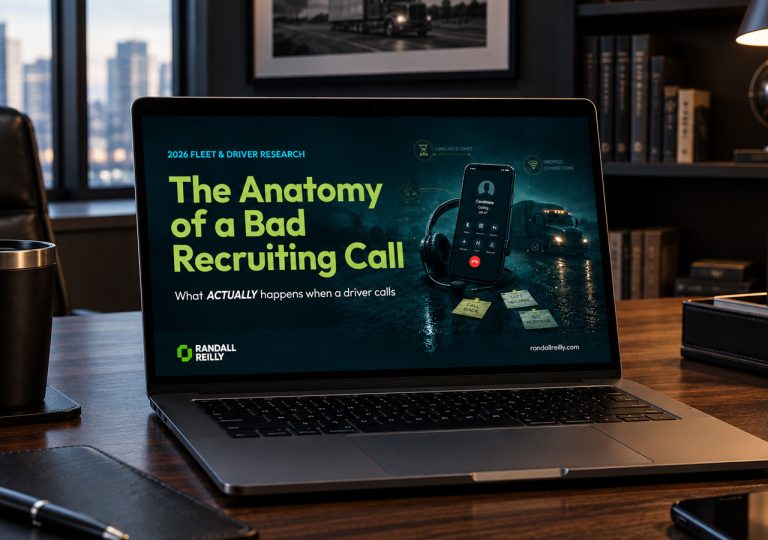
What did we find?
- 33.9% of calls in a disconnect before a real conversation ever happens
- 45.4% of drivers who give up on a call say no one ever answered
- 22.8% won’t call a fleet back more than once
- And much more …
Never Miss a Digging Deeper Discussion
Don’t miss your opportunity to share your thoughts and help steer the chat. Digging Deeper is back every month with a new topic. Dave and his panel will discuss the issues and field any questions our viewers may have. If you want to join us and become part of the discussion you can sign up to be notified when the registration for our next Digging Deeper opens up.
We look forward to you joining and playing an active role in the show!
Full Episode Transcript
What does a bad recruiting call actually sound like? Not what we think it sounds like. What actually happens on the phone when a driver calls about a job, and somewhere along the way, the opportunity falls apart. We recently analyzed more than 5000 recruiting calls, and some of what we found was pretty surprising. For example, 37% of drivers say that if they call a fleet about a job and nobody answers, they'll move on to another fleet.
And in the calls we analyzed, nearly 34% ended in a disconnect before a real conversation ever happened. But here's the number that really caught my attention. The number one reason drivers were calling wasn't to ask about pay. It wasn't benefits, and it wasn't even home time. It was to check on an application or follow up on a callback they never received. Almost one third of every call we analyzed was essentially a driver saying, hey, I'm still interested.
Is anybody there? And that's where I think this gets interesting, because we spent a lot of time in recruiting, talking about generating more leads, getting more applications, and driving more people into the funnel. But what if part of the problem isn't getting drivers interested? What if we're losing people who are already interested? We're going to look at where calls break down. What causes drivers to disengage? What happens when AI enters the conversation and what the best calls do differently?
What's the biggest reason you think fleets lose an interested driver on the phone? Is it not answering quickly enough? A bad recruiter experience, too much automation, not following up or something else entirely. Hey, we're about to get on this call and discuss it. We want to know what you think, and we're going to look at the 5000 calls and what we found. Live chat is open. Hey, let's talk about some driver recruiting calls.
All right, I just noticed let me add all my participants to the stage here. I just realized, I said, we're going to look at all 5000 calls. We're going to look at them all individually. Sorry. I was going to say I cleared my calendar. Good to know. Welcome, everybody, to Digging Deeper. I got the thumbs up from our producer. We got Josh. Joe Rogan has Jamie, I've got Josh. And, sounds like everything's working right.
Yes, the way we do. Digging deeper now. I mean, if you're a veteran, you know. But if you're a first time digging deeper, you, we sit here and talk about some of the ideas that we were just talking about. This was in reference to some research that Randall Reilly did this past month. McKensie was actually the person who ran that research and analyzed the calls for us. So we brought her on.
And, of course, Aaron is our resident recruiting expert in all things. And, but we want this to be more of a conversation. So if we say something and it doesn't make sense, or you disagree, or you want us to talk more and expound upon that idea, then throw it into the live chat. Or if you're shy, put it into the Q&A and that'll be anonymous. But we want everyone to participate for this to be a conversation.
But with that being said, Josh, did I forget anything? Okay. I will say, we will the link to the research we are talking about. I think we'll put that link up here at some point to that. You guys can all have access to it. If you have not downloaded it yet. All right. Let's get started. Mackenzie, if you don't mind. Why don't you tell us a little bit about how you did this research?
What we mean by we analyzed 5000 calls and anything else you want to share about the research? Sure. So when we say we analyze 5000 calls, that does not mean that we personally listen to 5000 calls. If so, this research would have come out years from now. We did use a combination of statistics and data analysis, as well as some AI assisted call dispositions to help us analyze these 5000 recruiting calls.
So we picked a handful of campaigns that are running both call disposition report on nine AI agent calls, as well as some campaigns that are using the AI agent so that we could get this spread of how do drivers interact with a real human, like a recruiter or someone in HR, whoever it is a human. And then how do drivers interact with an AI agent? And we got kind of compared statistics across both.
We found some differences, some similarities. And then as a whole, we just found a lot of enlightening information. Can I ask a point of clarification on that? And you may have already addressed this, but were those calls going in both direction or these are just specifically inbound calls from recruiters, from drivers in mountain calls. These are inbound calls only. Okay. Good. Good deal. All right. If you could pick a statistic that popped out from this analysis, what was the one that stood out the most to you?
Would you say so as far as a specific number goes, I'm not going to go down that route. I think the thing that stood out to me in general is in my head. I have always pictured recruiters all day long sitting on the phone with people who want a job, and they were just trying to sell them on their job, and they just talk all day long to drivers trying to look for a job.
This analysis really helped me realize how many calls recruiters have to work on a daily basis, where they're just passing that person off to someone else, or they're having to sort through prior applications or just busyness. Someone's calling in for safety, someone's calling in for HR. Someone's calling in to ask about their most recent pay stub, and it was just kind of eye opening, like how much recruiters do that outside of recruiting and how much of a workload that takes up of their time and how how much time they could be spent talking to drivers and actually doing their job, that they get caught up doing all these other things.
Well, it's funny, I just I just launched a poll because I put in some polls and I figured that would come up. And right now with six votes, we're at 5055. Do you or your recruiters field a lot of non recruiting calls. And maybe non recruiting wasn't quite the right thing. But I think the idea is how many calls do you feel. Well you're you're not actually in the process of convincing a driver to come work for you.
Aaron, you've talked to more fleets than anyone. Do you find that that is what McKensie is talking about, about how much time a recruiter spends on task and on the phone specifically that are not necessarily going to bring in additional drivers? Right. Yeah. It varies by fleet. Some, you know, much larger percentage than others. We need to pinpoint how and why. What are some because it's not always fleet size. Some of the smaller fleets still the recruiting team fields a lot.
So I don't know if it has something to do with IVR routing or anyway, I don't I don't know, but, I'd like to look at it. I hear it a lot. And then in addition to that, which we've talked about before, I know this is not the point of this conversation, is the amount of inbound calls that the recruiter answers. That is a recruiting call. It's a driver. Yeah, but they end up transferring them because it's not their driver.
You know, it's a scientist. Oh yeah. Which is also a nightmare. But I realize that that is not the point here, that it is a recruiting call and they should not transfer it. They should just work it as a team, manage it. Do not let that transfer go. I, I did see in the research I just as we're kind of on the front end of the call before we get we talked about the anatomy of a bad call.
But this will be a little bit more all calls. I did see that it said 34% of calls get disconnected. What are we McKensie do? What are we classifying as disconnected? What were the parameters around that? It could have been a number of things. It could have been the caller initiated the disconnect. So they hung up or really probably just they hung up. Or it could have been, I guess, tech initiated, like there was some sort of service was lost, or if it was using the AI agent, the AI agent disconnected it too early or something that was not the caller's doing, but more of like tech related.
Yeah. Go ahead. I had a question for McKensie. Maybe not for today, but based off that, I'd love to see disconnection rates by timestamp, because I do know a few fleets where it's much higher than 30%. And that's because their. IV our system or hold times are two minutes, three minutes or recruiting prompt is like number nine. You have to listen to a bunch of stuff before you even get the recruiting prompt.
Yep, those would be perfect examples of driver initiated disconnections, but that are due to tech issues like the technology for some reason caused the driver to disconnect that call. You guys are just hitting on all the polls that I already had queued up. I didn't know you guys are going to ask all these things, but, well, if we did better, maybe this is good for a good, you know, organic discussion, but it's a folks knew that we had no idea what polls you were going to bring up.
We are being honest. We had no idea. Yeah. Yeah. So. Right. We're talking I don't know if you guys are seeing the polls, but, 60% so far say that their recruiters feel a lot of non recruiting calls. And, when we ask what percentage of your calls get disconnected. 70. No one has said greater than 34%, which was the average in our analysis. 75% have said less than 34% and 25% said idk or I don't know.
I will note that 40% of our listeners do not track how many inbound calls their recruiting team gets, and so far, 100% of people have said that recruiting is above option three. And, wait. And now we have a vote for exactly option three on where you're at in the IVR, which I think you always say, Aaron, that it should be two or above or is three and above. Okay. I mean, it depends on how long.
To me, when you look at the duration when option for recruiting comes up, is it come is it presented at 15 seconds 45 seconds. Okay. All right. Well, let's, let's kind of talk about if if I think that's kind of where I went ahead next a little bit is, you know, with the disconnect they called, but then it got disconnected. So I think one fix would be, hey, let's make sure that recruiting is at least three and above on, on our IVR.
And it looks like most people here are, are, are doing that. But you are even saying like you need to think about the time. Like that's probably a better thing to think about is from the time of answer, how quickly do they get to the menu? And then another thing we mentioned was that I'd like you to dig into a little more. Aaron, that might cause disconnect is a, a recruiting person answers the phone and but then they end up having to, I guess forward you to another recruiter because that's not technically their lead or driver.
What would you say is the best method to kind of solve that? I mean, twofold, one would be some type of a team recruiting team bonus, commission bonus for hires, for applications, for schedule, for orientation. And I do think a lot of folks have that. But to reinforce and incentivize that, that call is also that driver is talking to 5 to 7, 6 to 8 fleets at a time, and that there is a I don't know what the number is, but 40% drop off rate when you transfer and then they hit the IVR again or they hit voicemail and you never talk to them again. So what? I'm surprised by you. When we listen to these calls, it should be easy.
And you don't hear it very often where recruiters says, hey, it looks like your recruiter is so-and-so. I believe they may be on the phone, but what kind of questions do you have? Or what can I help you with? You don't even hear that one question. It may just be one simple question they have. Yeah. And I guess that's just if you put that practice in place, you know, and train people to like, hey, everyone can field these calls.
It wouldn't be. I mean, they obviously have the ability to answer the question. It's not like it's going to be an answer question. It's just they're just so used to what you don't work other people's leads, I would assume. Edward Conley says with their fleet, their recruiting has its own number. There is no option for a driver to hit to, to reach recruiting. So it's more of a recruiting direct number type thing, which I think a lot of fleets have, don't they, Aaron?
But I think even so, some people will end up calling the corporate office or not call the direct recruiting number. Yeah, I would assume there is a, you know, a main corporate office number that sometimes a driver will call. How do they get to that other number? And I will say doing a kind of a secret shopper for potential client the other day there. It's this was unusual. But their after hours number said, hey, if you're trying to reach operations, hang up and call this number.
If you're trying to reach recruiting, hang up and call this number, which I thought was extremely antiquated. There was no option to direct them there. They actually had to save the number or write it down, which, you know, they're driving and then call that other number, which I don't hear that very often, but I thought that was a terrible experience. All right. God, what was I. I was just about to we we talked about kind of two things.
We talked about, Wow. What was the other one? I was going to ask you about how to prevent. Well, no. Someone asked, what is go ahead on this, Aaron, because someone asked, what is the secret shopper that you just talked about? Am I able to see what you're saying? Am I supposed to go to chat, or do you just. Yeah. You just open the chat. If you open the chat, you can see everything we're seeing.
That way you can respond. You can put stuff in the chat, too. Okay. Secret shopper I jokingly say this a lot on calls, but when we're talking to prospects, it's a speed date on both ends. Are we a good there? You know, they're obviously vetting. Are we a good fit for them. But we have done a better job of doing some due diligence on are we good fit for them and are they a good fit for us.
So you know, do they take calls. How do they manage leads? What is the phone system, all that kind of stuff. So that's one of the things that we do in current clients and, potential clients just taking a look at what is their system to after hours and weekends. Because I, I will say we're in the early stages of, you know, AI and I do think some people have some misconceptions. And there it is very common to hear, you know, we're just we're just not really interested in AI.
Drivers don't want to talk to AI. We want them to talk to a real person. I'm like, well, we called it 9 p.m. and waited on hold for two minutes and then got put into a voicemail. That cannot be better than a high quality AI that can answer the driver's questions, capture, you know, do a pre screen and then submit that lead into the system, which I have some stats on that I don't have them off the top of my head, but I think my stat person will.
What is the the rate. You know, because we obviously have a, a call Agent Stratus agent and we have stats on what is the actual how often do they stay on the line when when the because it identifies himself as an AI agent. And what are the stats of which they stay on the line for that? To me on it not, it's somewhere around 85%. I think it is 85%. That was going to say that, my stat guy will confirm, my other question was so we kind of talked about kind of on the front end of the call, we got, you know, they come in and they disconnect for whatever reasons.
They get transferred the eyebrows too long. But then we talked about a lot of people calling in that are not necessarily they're either getting transferred out because they're a current drive or asking about something or you know, that it's like it's a non-qualified student or something like that asking for more details. What would you say? And this is for the panel here. What would you say? How do you prevent that and somehow give recruiters?
Because I assume everybody here and I may be wrong, but I assume everybody here, once they're recruiters, spending the vast majority of their time talking to interested drivers, convincing them to fill out a full application and get scheduled for orientation. What can you do? And we don't have to exactly say what we do, but what are some other options that you can do to mitigate the amount of waste of time on that sort of thing?
So use speaking specifically to certain pieces of that, like drivers calling to confirm what endorsements are needed or confirm what routes are available, what locations they're hiring, and things that are just like basic requirements and details about a job. That's something that AI can easily handle. You put an agent in to answer phone calls, and if it's just a driver asking about a job and what the qualifications are, you can give an agent a knowledge base, and the knowledge base, or the agent can answer based on the details in that knowledge base.
So that can save up a ton of time on just strictly answering questions about the job details. The next step then becomes, how do you convert a driver who's asking about details into someone who's actually interested in driving for you? And would you? Yeah. Go ahead. I think I think she nailed it. My the only thing I would have is there's a lot of time recruiters then chasing follow ups, you know, whether it's a voicemail or I missed a call.
And they don't know if it's a good lead to follow up on or not. So it is kind of a blind follow up. And I do think her point. Would mitigate a good percentage of those. You're going to answer their questions. The information the agent cap, you know, captures on that call will submit. And then if there is a needed follow up, that recruiter can prioritize because they have, you know, all the information even to I guess, one of the questions, you can customize what she asks or he she asks, however you set it up.
One of them is, you know, who are you currently driving for? And I know we've got a few fleets specifically in the niche, industries or markets would say if they drive for this carrier, I absolutely want to talk to them because, you know, I know they have the qualifications we need. So I think that's a big piece. Yeah. And you know, the so not only it it feels like a win win on the on the having you utilizing AI to field inbound calls because.
According to the research, you know 37% of drivers will move on if no one picks up the phone the first time. So you just have the the hey, you know, we got you know, we have all these inbound calls. We're only able to feel so many, not from any sort of negligence, just, hey, I'm already on the phone with somebody else and I'm fielding all these, you know, calls, so, hey, I'm not missing any calls.
B, I, I'm able to screen away the calls that are not a good use of my time. Kind of forget where I was going with that. You sounded good. Yeah. So an additional piece kind of building on that last statement is we've just developed some new skills with our agent that can transfer not just to, like, a general recruiting line or a general voicemail, but can transfer it to specific individuals. So someone who's calling in for safety, we can transfer them directly to safety or someone who's calling in to speak with a specific recruiter.
We can transfer them to that specific recruiter so that as AI gets better, its capabilities and skills grow, and AI just can be a great tool to solve some of these problems. Knowing that AI can't replace everything, but it can replace a lot of these like tedious, time consuming tasks that recruiters time is better spent doing other things. Yeah, I forget where I was going with that, and I'll probably remember later when I'm eating a hoagie, but, go ahead, Aaron, I have one that has nothing to do with an agent, but I guess it's still part of our research and still blown away by the amount of calls that follow in that disposition, where a driver is following up on an application.
Yeah. And it does. You know, as you dig into those calls, it's disheartening from an advertising perspective when the application was filled out on Friday and it's Tuesday afternoon when the driver's calling and still hasn't heard anything. Yeah, that's a big deal. So anyway, I, I, I do think there's something to dig into there on there process and how quickly those are followed up on. Well, that's where I was headed next.
So we've kind of talked about, you know, the disconnect or things coming in that are not necessarily as relevant, but then you have the parts that are pretty relevant to the recruiter, even though, you know, it's like, like the callback thing are people calling and they're interested. But so the what was the the number one reason people call the number one disposition when people called was the callback on the hey, I filled out an application, so let's get to that one next.
But the one out there was also one that was high on the list of when they called us that, they, When they called a, they were looking at OTR versus local, like they're calling and saying, do you have any local, you know, regional routes? What is what do you see as the cause for that sort of mismatch happening? Aaron, it seems like I mean, if you're looking at a job post on whatever, it would have the sort of details that let you know, you know, this is not, this is not a the job for you.
They don't offer that sort of route. So what do you think causes that? Yeah, I know we've looked at this before and we've talked to our performance team about how to better, what's the word you kind of have to. You're juggling the algorithms of a job board. Yeah. What is the subject line? How do I create a good job heading and job the text, the body of the of the job posting.
Right. But and this is not a knock on indeed. Or zip recruiter or any of the job boards out there. The way the ad comes across, the way they present it to the driver is you. You live in this city and they have a job in this city. Exactly. For you kind of thing. It is worded as if it's a local job instead of that is one of the hiring areas that this, you know, this job could get, could get you home more often.
And so it's a little bit of an unintentional bait and switch. And I would just encourage people to take a look at their job listings or if they've got vendors running some advertising for them, how that job is presented. Because it, it sometimes, it never says local in the job listing. It's just the way it's presented by those aggregators, like a recruiter or an indeed. And it looks like a local job.
That makes sense. Two things from our audience. Edward says I can't speak for everyone, but if an application came in on Friday or over the weekend and I have not called them by Tuesday, it's because they are not a fit. And then Andrew Brown says they forget to read the line in the ad that says it's an otter position, which I assume is a fair, a fair amount of it. And then Cheryl says, or they saw it was Otter, and just hoping that there are other openings too.
So that's the direction I was going. I feel like it also reflects just a trend we're seeing in the industry, which is both that carriers are starting to offer more local routes and drivers are more and more wanting local routes. And so I think a lot of it's like wishful hoping, like, let me call and just see, maybe even though this position doesn't say they have local, maybe they have a local position that they could offer me or something.
Yep. I mean, that's exactly it. They, that they run the ad for the job they need help with, but that doesn't necessarily mean it's the only job they have. Yeah, as a carrier. So that's part of it. I also think OTR is an ambiguous term. We throw it around a lot and it means something different to every fleet and every driver. Now I will say, you know, to Cheryl's point or to Andrew's point, OTR does not mean local, but there is some ambiguity there.
And I, you know, I can't fault the driver for just checking. Hey, I want to see what else. And you see what Cheryl said? She said, at the very least, that driver is now in the system if when a local opening comes up. So that's a good point. I would also I want to piggyback off that because I guess with a lot, not only if a local position comes open, but we do try to help recruiters, you know, craft their pitch to say, hey, what kind of money are you looking for?
And a lot of times the money they're looking for does not align with the local position. And so hey, if you don't find that job, I would like to have an opportunity to talk to you about ours. You know, if you can't make 1800 a week and be home every day, I've got something you may be interested in. It may not be local, but anyway, I do think a lot of times they want local, but they also want to send a week.
Lisa said. We have recently updated our application asking if they are applying for local, but also if they live within a 50 miles of location positions. Good to know I would. Oh go ahead Aaron. I would like to talk maybe. Lisa I would like to know more about what they're doing. You know what applicant tracking system they use? Because we came across an issue with a client recently that did something similar.
And the driver we could see from our campaign, the driver had submitted a, a form, an interest form for the regional campaign. But when they. And this was actually this client used 10th Street when they got to the Intel app on 10th Street, one of the questions the company had added was, what route are you interested in? And local was one of the options. And then they were changing their answer to local.
Once we started calling the drivers back, just asking like, hey, you submitted a job about regional, but on the application you said local. Their answer was why? Didn't know local was an option, so the client was inadvertently hurting themselves because they added that local question to the app. The last thing I want to ask about, because I try to keep these things around 30 minutes. The last thing I want to ask about is, so there were a couple other kind of negative triggers, you know, for when people called in and got connected.
One was the, the and we kind of talked about this already, but the I'm calling to follow up on an application I put in, I haven't heard from anybody. What is the cause of that and what's the fix for it? So that's what we have been talking about. I mean, that's what they were saying in the chat, is a lot of times they haven't followed up because they don't qualify. I legally I don't know the right answer here because I do have some fleets.
You know, the, if you're declining them, you have to send them that letter. Right. So I, I don't know legally how to speak to this. But I do think from a client. You know, when we do branding campaigns, a client, just quality score and what drivers think of them, I think it helps you to engage with every one of them and tell them they're not qualified, instead of them never hearing back.
Andrew says tell and tell app to have a better candidate. Job tracking experience. I think fair point. Fair. I think he made that for you, Erin. Go tell Mr.. And tell you that. I agree. I mean you asked about the calls David when it depends on the size of the fleet, size of the recruiting size, how much money is being spent on marketing and generating inbound leads. But sometimes there's so much inbound phone calls and forms that you just can't get to all of them.
And then by the next day you've got a whole nother set come in. And just inevitably, ones keep getting pushed and pushed and pushed down the pipeline. And at some point you're like, oh goodness, that was from two weeks ago. There's no point in engaging with it now. And all of that is absolutely reasonable thinking. So then the question becomes, well, what can you do to try to combat some of that?
What sort of automations can you put into place? What sort of tagging and lead scoring and tracking could you put into place like the the calls is a legitimate cause, but there's still things that could be done to help with that engagement rate so that these ladies aren't just going uncontacted. Right. And I mean, do most I think we've talked about this in the past, Aaron, but if someone is interested, they've submitted their application and you're interested in them.
Is there some sort of like pizza tracker system ever that they have where it says like, hey, you're applications in review or your application is, you know, has been approved and you should expect a call back at this date, right? Yeah, I know that's one of the things we're working on with our, you know, with our technology, with the AI, the ability in your example here, it's more of just the earlier part of the process, keeping the driver informed.
But even the post approval process follow up, you know, if they're scheduled for orientation a week out, same thing applies. Reach out to them just with next steps. Hey, your rental car is being booked or we're looking forward to seeing you Monday at 10 a.m. but that is a big piece of just automating that, taking some of that. That's a heavy lift for a recruiting team that hires, you know, 20, 30, 40 drivers a week.
And you were just saying that we say best practices or recommended that even when even when you don't, the application is unapproved or they don't have the necessary qualifications, you still would want to have some system to be able to let them know. Like, hey, your application has been reviewed and you don't quite meet the qualifications, but you know, you know, whatever you want to say, give them the easy letdown of some sort.
Yeah. Again, I'm that's easier said than done for recruiting, right. That's a that's a tall task. But that's kind of either that or you have somebody that's dedicated to that. But they do the outbound phone calls. Yeah. To to talk through disqualification. They're not qualified. All right I'll give each of you if you want it. You don't have to. But if you want it, one last kind of summary of what we talked about today.
And then after you do that, I'll do my usual sum up and we'll get out of here. Mackenzie, anything you'd want to add to what we talked about? I wish you had started with Aaron is what I want to add. Aaron. Go ahead. I can do something that I. It's more of a question I have found from the clients that are currently running are, are called agent. A large percentage initially said we don't miss many phone calls during business hours.
I would venture to say more than half, maybe 60%, have been surprised at the amount of calls the agent has answered during business hours, and they were not aware of it, so I don't know what that means other than a large percentage of drivers called during the day, didn't get somebody, didn't leave a message, I don't know. But to me, when we looked at the data, if you missed two calls a day just to our data on phone calls and hires, that, that results in 1 to 2 missed hires a month, which, you know, whatever that is, 40 or 50 000 in revenue just from missing two calls a day.
Wow. McKensie. Did you have anything you wanted to add? Yeah, I'll throw out something that I found interesting, which is that nowhere in the analysis did we find that a significant percent of people dropped off in the middle of talking to AI. And so we have people we have callers who are hesitant to talk to AI from the get go, but once they start, they seem to follow through with it. Once they start interacting with the agent and see how lifelike and easy it is to have a conversation with an AI agent.
And so I find that encouraging, also challenging that we have this kind of bias. We have to get over people not always wanting to talk to AI in the first place. But the encouraging part is once they start, they really have a good experience and they very rarely say like, oh, I'm tired of doing this. Let me hang up. It's a good experience if we can get people to actually connect with the agent.
Can I answer those two things that we're in the chat? Because, Anderson, you would Andrew has a great question. And then Velma, I we have to go to dinner again, and I owe her dinner and a drink for sure. Our team is saying outbound calls are coming in the next 60 to 90 days. I know that we have an API that's supposed to be finalized in the next two weeks, from what I hear.
So she's tired of me saying that, but I promise you, I'll make it up to you. And then, Andrew, it's a great question, and I don't have the data in front. I know we have some of the data on 8 to 5, but, Andrew, I want to mention we've already sat internally and we want to run some tests because I think we're part of the problem on after hours. I want the ads to say we're available 24 over seven.
Any questions you have, call us. And I want to get the uptick in calls at 2:00 in the morning, 3:00 in the morning, because the agent can answer the questions. But right now, I think most drivers are conditioned to not call it three in the morning because they know nobody's going to be there. But we want to run some ad tests where we're encouraging the calls after hours and see if we can in that number.
So I don't have the data in front of me. Oh, well, I think unless we have any more questions in the chat. Good point by Andrew there. You want me to. All right. I'm going to do it. There we go. There's the link to the. Didn't mess it up. There we go. There's the link to the research that we've been referencing. I know some of you have already downloaded it, but if you not have not, there's your opportunity.
And then the other question that usually gets asked is, will this be available? Yes. The full Digging Deeper will be available on YouTube tomorrow and on Randall Reilly.com tomorrow. And I appreciate everyone for joining us. And thank you, Mackenzie and Aaron for being on. And we will see you again next month. We're going to talk about ghost. It is Halloween month. So we're going to talk about ghost busting and all the things you can do around to prevent ghosting from drivers.
We'll see you then. And thank you very much for joining me.
Explore More Topics with Digging Deeper
Digging Deeper

28:05
41:50
28:34
46:19