

What Sets the Best Recruiters Apart?
What separates a good driver recruiter from a great one?
The differences aren’t usually as dramatic as you’d think.
Then what is it? It’s the little things that happen during the everyday recruiting conversations. Knowing what to ask. When to ask it. Building trust. Understanding what matters to that driver. And making sure every conversation has a clear next step.
Get 7 Things the Best Recruiters Do
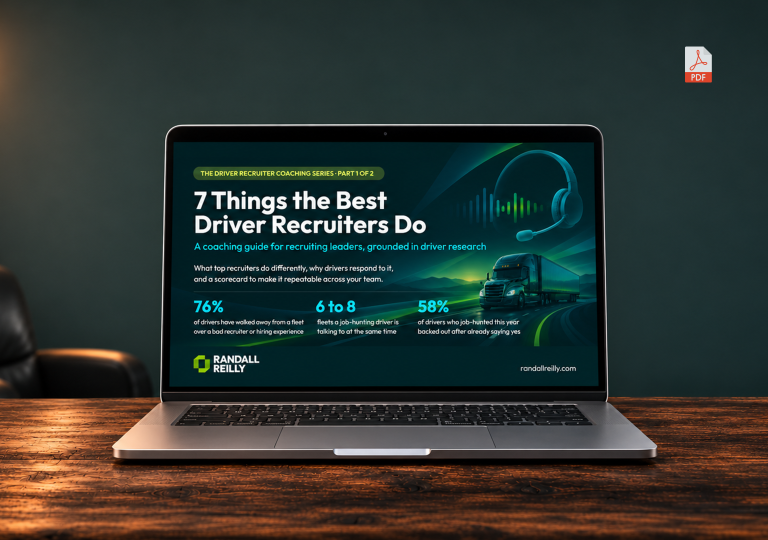
What did we find?
- 76%of drivers have walked away from a fleet over a bad recruiter or hiring experience
- 6-8fleets a job-hunting driver is talking to at the same time
- 58%of drivers who job-hunted this year backed out after already saying yes
- And much more …
Never Miss a Digging Deeper Discussion
Don’t miss your opportunity to share your thoughts and help steer the chat. Digging Deeper is back every month with a new topic. Dave and his panel will discuss the issues and field any questions our viewers may have. If you want to join us and become part of the discussion you can sign up to be notified when the registration for our next Digging Deeper opens up.
We look forward to you joining and playing an active role in the show!
Full Episode Transcript
Welcome back to Digging Deeper. Today. We're talking about coaching our recruiters. And this stuff tells very nicely into our last topic of ghosting and how to prevent it. So we're going to get into the nitty gritty of a lot of the reasons why fleets get ghosted is because the stuff we're covering today, we're going to cover the seven things that the best recruiters do. And this is part of a this is a two part series on coaching recruiters.
Come join us today on Digging Deeper. We have with us Aaron Mallory, our vice president of strategic accounts. I'll start with this. How important is it to offer training or feedback or coaching to your recruiters? It's not very. Just wing it. And that's our show for today. Being in offices with recruiters, one of the first questions I like to ask is, is recruiting sales. And I like to get there's no right or wrong answer there.
I like to get everybody's feedback. But what's the general sentiment? I think most recruiters do see themselves as sales. Now you'll have a few that say, hey, I if has a negative connotation, I don't want to sell somebody. They don't want something they don't want. But, I guess my point is me being in sales at our organization, we're constantly trying to improve. Yeah. How our salesmanship. Right. And it should be the same for recruiters. Yeah.
How do you have an indication? I mean, the fact of how much, you know, Modern Auto was booked up and how much you started. I mean, I think people see the need for that, right? More see the need. I don't think it's as pervasive as it should be. And even individually, if it's not the leader, the individual sales rep, recruiter, I mean, any profession you're in, I don't think we value constant, consistent learning as we should.
Like, are you getting better? Right. You know, it's like the I mean, Seth Becker, you always do. The thing about, you know, you've been typing. Typing, I love that. Yeah. It's that whole idea of, like, if you're just constantly in performance mode, you don't actually take the time to improve, like, that's why you're typing. It's been the same for the past ten years. Even though you do it every day, you don't.
You're not actually setting aside time to improve. It resonated with me because I. I still am not a good typist. It's not I'm not a type or a typist. Is that I even know if that's the right way to think. That's right. But I could say, hey, I yeah, I've been using a keyboard for 25 years. You'd think I'd be great at it. I am not great. I don't actually practice. Yeah.
And the thing was, like with your recruiters, his whole point was, you know, you have a recruiter that's been doing it for ten years, but unless he's taking time to improve his craft along the way, he's just repeated the same year, year 110 times. Essentially. Yeah. Which is which is which can happen. All right. So let's talk about we want to talk about the seven best things that driver recruiters do. This is part of ongoing research that we've been doing and working based off of our interaction with recruiters, driver research and just, you know, being in the industry as long as we have, so we're going to go through these kind of one at a time really quickly.
Give a quick overview. The full research is now available, I believe are not at the time of filming this, but at the time of this being aired, it will be, we hope anyhow. All right, let's start. The first thing that we talk about here in this research is just how important it is. And I think we even made the point. The best salespeople know their products really well. The best recruiters need to know the job really well.
Now, I assume being not as involved in and having not listened to as many phone calls as you have, I would assume they know the job, but it feels like there's something more here of like there's a step above knowing the job. Yeah. And listen, this is an aggregate of hundreds of clients and meetings. And I do think a lot of people out there are doing certain things really well. Yeah. And then a lot of folks, all of us probably would say there's 1 or 2 things we could do better.
So this is kind of an aggregate of the things folks do really well and the things that, hey, we see overarching themes. Yeah. But when you get in a room with a lot of recruiters and just trying to get a feel for, you know, the chemistry, the vibe, some folks have been there ten years, been there six months. And you just asked the question on, hey, what do you guys pay? Yeah, let's listen to a couple of recordings where drivers asked that question. And it does vary.
I mean, it is are you concise? Yeah. On how you answer that question. And again, I in this current market, a lot of that stuff's changing fast. Right. But there is an overarching theme that says sometimes we don't answer that question very well. And again, in their defense, yeah, if we do the sales pitch, you know, the elevator pitch of rain. O'Reilly hey, what do you guys do over there? I bet you our sales reps answer it 4 or 5 different ways.
Yeah, that's true. And then I guess the other part is, you know, drivers are responding to job listings and ads that they've seen and that and you want to make sure that the, the, the information that you're providing is a recruiter matches what they're seeing out in the world. When you say yes. Now, this is I mean, there is definitely room for improvement here. And I'm going to put this more on the recruiting.
Directors, vice presidents. Yeah, I've been at multiple offices where we'll talk about miles a week or cents per mile, average weekly pay. Obviously, those all three go together. How many miles are you getting a week? What's your sense per mile. And so what does that equate to in an average weekly pay. And the recruiters have different numbers. And then we bring ops in. Hey there's some questions here right. How many miles on average as a driver going to get a week.
Because that is a question these recruiters need to know. Right. And they'll throw out some number and leave the room. And recruiting will look at me and be like, I don't believe that, or I'm not going to say that. I'm like, gosh, you guys all got to get on the same page. So, right. Yeah, that's a big deal. Yeah, there's some I, I remember in the research there's some other just good things to know like, a little bit of history of the company, whether the company is, private equity owned Esop.
Yeah, all that kind of stuff. That's good stuff to know. But the main thing is, I think when I, when I was reading through some of the research, the gist was you don't you don't want to just have your canned scripted answers. You want to know enough about the company and be on the same page with everybody so that you can field any sort of question the driver might have with ease.
And again, one of the things to learn is if you get in a room either weekly or monthly as a recruiting team, listen to a few calls and hear how these other recruiters answer it right. It also helps they kind of that group learning experience where they help each other. And you mentioned just a few, but I mean, what equipment do you have? What years are the equipment? How long is orientation.
Where is orientation held? Some of them they got to know. Yeah. How is the sign on bonus or, transition bonus paid out. Right. There's a lot. Yeah. Yep, yep. All right, let's move on to the next part. Talk about you start getting into the phone call a little bit more when we talk about kind of building rapport and both building rapport and then kind of aligning the benefits of the fleet to the pain points of the driver.
So when we talk about building rapport, what do recruiters need to focus on in that framework? We probably should do a some type of an audit on phone calls. What percentage of the calls coming in from a driver that's answered by a recruiter? Does the recruiter say their name? Yeah, say the company name. Say the department you've called. And then how may I help you? Right. And now you may roll your eyes at that.
But the first part of building rapport, just start off nice. What do you what do you. And and I know this is based off of what we've seen good recruiters do. So obviously this example is out in the marketplace. What are the examples of what poor, poor interactions have looked like? What do poor interactions look like? I think the recruiters are they're busy. They're typically multitasking. They are moving from one call to the next, or they've just gotten off of a outbound call.
Or maybe they've tried 4 or 5 calls and hadn't gotten an answer. Right now they get an inbound call. So I try to be empathetic that it can be monotonous. Yeah. And it just sounds like they get robotic. Yeah. And, and they're not they're not identifying themselves necessarily, or. Yeah. Wow. Hey, this is Erin. Oh, I even hear that. Or, this is Randy Raleigh. How can I help you? Yeah. You may get some of it, but not all of it. Right.
Not the name. So, anyway, building rapport starts with that. Obviously, that's just one piece. And then the, the other part of that, a big part of that was the idea of, aligning, you know, uncovering their motivations, understanding why they're calling, why. What about the last job they didn't like? Why is that important? This goes back to a mindset. Are you just punching a clock to get paid or are you actually trying to make a difference?
So to me, recruiting is a pretty powerful position. The company is relying on you. I mean, they don't make money unless the trucks are moving, but the men and women who are calling. I mean, it's their livelihood. So I don't ever want to take that for granted. So to me, just being a real human and asking some questions about, hey, I want to make sure that what I'm offering you is actually a benefit, you know?
Is it a benefit for you? And are you guys coming over here? Would it be a benefit to our organization? Sometimes that's not a good fit. So. Right. That's got to be the overarching theme. And if it is, I think it'll change the way your conversation goes. Hey, John. You know, thanks for calling. Tell me a little bit about yourself. What are you looking for? What are you unhappy about? Yeah. It's just feels like it is less robotic and let.
Consultative is a word I use. But let me find out what's going on. What? What are the kind of the pain points that you want to uncover in that question? If you're if you're kind of trying to find them out and, you know, you mention the question, what don't you like what what you like about your current job and things like that? What are the things you're hoping to uncover there? I want to find out if there's something here that is actually better.
Right. We do the same thing with clients when it's a random Riley, presentation. Right. And they're unhappy with where they're at. Hey, tell me what you're unhappy with, because I got to make sure that we actually have something different or better, you know? So that's just part of it is, you know, are you upset at your dispatcher? How many jobs have you had in the last few years? Because I also want to find out. Is this a knee jerk reaction?
Do you leave when something bad happens? Because something's going to happen here, too, and we're not going to be perfect. So just kind of finding out that temperament of the driver, what are they unhappy about? And if I have something that can help them, if their equipment keeps breaking down and my equipment's listen to your old. I absolutely have something for you. Okay. So the next. So that was actually three and four.
We've already been through one and two. Now three and four. You're going to have a hard time keeping up because we're going fast here. What was it? Oh. So yeah, the first one is like this is not necessarily on the phone but knowing. So number one know make sure you understand the company know the role very well so that you can field questions. Number two is make an impactful introduction which you kind of covered there.
The idea of you know you know the I this is there and and and then the third and fourth are build real rapport. So actually take an interest in them. Tell me about yourself. The fourth one is, you know, become that consultant, start understanding what they're looking for, what they didn't like about their last job, so that you can say like, well, here's why you may like this better, but you may even have to say, hey, if that's something that's a real hangup for you, I'm this may not be the right fleet for you kind of thing. Well, let's talk some more.
Let me find out what else is going on. Right, right, right. And so number five and six we're kind of covering them together. You want to be able to handle objections restaurant. And then, let's just start there. So the idea of handling objections, what is that? What does that even look like on the phone? I do think that this is the big one. The majority of the phone calls. Well, let me back up.
We go to a client's office. You kind of want to do a T chart. You know, here's the positive. This is all of the benefits that X, y, Z company offers. Right. And then on the other side, every recruiter knows, hey, what are the 3 or 4 things that maybe you aren't great at or the driver cringes at right when you bring up? Maybe it's slip CD, maybe your equipment's old. Maybe you have to be out 7 to 10 days.
You know, obviously everybody's gonna have some. There's no perfect fleet. You make that t chart, and then you look at the list, of the good and the bad. And then you work through handling those objections. The top 3 or 4. Again this goes back to a mindset. If I'm handling objection to trick you into coming. Right. That's not the goal. But if I'm handling an objection because they've called and they're extremely unhappy where they're currently at or they need something else, then maybe my positives outweigh the 1 or 2 negatives.
Yeah, yeah. So to me that that's the big piece. And to your point, the thing you kind of mentioned here is it is an exercise that you would have to actually make time to, to work on as a team. This isn't something you necessarily are going to do on the phone. This is hey, we're just make a T chart and make sure that we can understand how all this fits together. That's right.
And I mean, we can remember what your initial question was, but if they're at they're throwing out at the very beginning because you'll hear some of these savvy drivers to say, hey, what's your CPM? Yeah, I mean, that's right off the call. My name is John. How are you doing today, John? I'm doing good. I'm calling to find out. What's your sense for mile? Yeah. And a lot of recruiters just, They're going to answer that question even if they know it's not great.
We're $0.58 a mile. Yeah. And the driver says I'm making more than that. I'm out. Yeah. You've lost them. You are not handling objections there. I mean, you've got to have your phone system do that. You're not a sales person at that point, right? That's a good point. Yeah. Yeah yeah, yeah. With the how much AI is coming along, even the things that we offer stress agent and things like that, if you're just giving information that you're not really performing the the role of a human being in this scenario.
I mean, I had a sales leader years ago say something to the effect of that, that, hey, if you guys are just going to pass out information, I can save a whole lot of money and just build a some pamphlets, go make some really nice pamphlets and mail them out. Yeah. Why do I need y'all? Yes. Right. All right. The six thing. So you've kind of let's kind of recap real quick.
So we want to make sure before the phone call that we've armed ourselves with all the information we need to understand, like average miles in a week, average pay per week, you know, just history of the company knowing the equipment. Well, so that we can answer any sort of question. We want to make sure that we make an impactful introduction so they feel like they want to be on the phone with you.
Then you're going to build rapport, find out about the person, start feeling more like a human. And then after that, we're going to uncover the motivations of the driver so that we can align the benefits. Then any sort of objections they have. We want to be able to treat those like a consultant rather than just, you know, we're not trying to trick them into anything. But we also want to be able to sell and align to what they're looking for.
And then finally, once we go through that, we need the ability to summarize, which is what I just said. Summarize it all back to them. Why do you think that's important? This gets missed a lot. And I on the safe side we missed this a lot too. But just hey, it's been great talking to you. I'm going to go through the 2 or 3 things that we talked about. I put some notes in my system, make sure that we're on the same page and then give you a few next steps.
It just helps them either agree or disagree. And then the ability for the recruiter to say what else did I miss. Right. Who are other carriers you're looking at. What did you not like about what we talked about. And take those notes down. Kind of really puts a bow on it at the end. And and you can find out if they are this. To me, this is a big piece. When folks feel like they're getting ghosted.
Right, it's because they don't do this last step and they're just, I'm gonna send you a link. How does that sound? A recruiter or a driver is just going to say, yeah, that's fine. Yeah, yeah, yeah, they're just being nice. Yeah. You're not really, closing the gap there. Well, this dovetails nicely into the seventh habit that we said that great recruiters do is they inspire action. At the end of the call, there's some sort of thing to say like this is the next step.
I'm not just waiting on you to, you know, I'm not just tossing this out into the ether. I actually have a step. What does that look like to inspire action at the end of the phone call and even ask the question like, hey, how quickly are you wanting to make a decision or a move? I want to find that out. How can I help? It sounds like based off what you've told me, we would love to have you.
Yeah. I'm going to send you this application link or I've started the link. I just need you to review it and finish it. When do you think you can get that done right? I'm just trying to find out. When would you like me to follow up? Like I want them to feel valued. I'll call you this afternoon or tomorrow. I don't want to lose you. Yeah, and that's the point I've heard you say multiple times, and I think I've heard other people say is it's not always you're not always able to do this.
There are some restrictions on this, I think. Company, company. But if you can start the application on the phone, go ahead and start it. At least part of it. Yeah. Of all of those. So if we talk about like knowing the company really well having an impactful introduction, building rapport, uncovering motivations. Being able to handle objections like a consultant. Being able to summarize the entire phone call back to the driver and then finally inspiring some kind of action if you were to.
What do you think? Obviously, you'd want to look at each recruiter individually and say, this is where you have the biggest opportunity for improvement. But just in all your experience, where do you think is the biggest area of improvement for most fleets? There's a two part answer to that. Okay. There's 2 or 3 things that are easy wins. Yeah, just your introduction and building rapport. Yeah. Easy wins. Every recruiter can say, hey, I'll do that.
And it should be a pretty easy change in behavior okay. The more difficult would be the handling objections. That's the most valuable. It's also the most difficult to do. So to me if you're going to only pick one, pick the biggest that you'll have the most impact on. But there's also 2 or 3 really small ones that maybe only improve your call and your app volume, you know, 10%. But they're easy to change.
And I am like man you guys are missing out on this. Yeah a good point. I would like to say I don't want it to be just philosophical or you know, maybe that's not the right word but actionable to me. I want to go back to the the first objection, whether it's, hey, I want to be home. I want to be home daily or I already make more money than that. What's your sense per mile?
I do want to tease if anybody would be interested in having a conversation afterwards. Those are. Those are absolutely objections that should be handled. Hey, I, I want to run local. Hey, I get you. I've been recruiting for ten years. That comes up a lot. Everybody wants to be in a home more often. What are you doing now? I may not get this driver, but I want to hear. What are you doing now?
Are you currently driving local? Yeah. And what are you looking to do? As far as pay, right? Because they may want local, but they're currently out three weeks at a time. We hear that a lot. Yeah, they're going from one extreme all the way to this one. Right. Can we meet in the middle? Yeah. That's where they want a unrealistic weekly pay. Yeah. That you're not going to get local. Is that generally the the rule of the market is the longer you're out, the more you make generally.
Okay. There's going to be some people on this call that I mean, in the market we're in right now, there are some great jobs out there right now. And you don't have to be out three weeks at a time. But I guess my point is you can handle those objections and at least keep the conversation going. Yeah. And you'll uncover, I don't know, 25% that would be interested in your job, even though initially it sounded like nah, they don't.
They just want local. One last final thing before we're done here. Let's say there's a director of recruiting on the call right now, and I'm sure there is. And they say, this is great. I'd like to start providing a lot more feedback and coaching opportunities for my team. Where would you say is a good starting point for kind of getting the ball rolling on? We want to take some time to practice and not always just be performing.
The teach art would be a good start. And then second, if if their current client of ours, they should have access to call recordings. Yeah. Even if they're not a client of ours, I would assume their phone system have some recordings. In my opinion, that's where you would start. Pull out a batch, get together as a team. It's going to be awkward at first. You're going to listen to a few. You're going to find 2 or 3 things that they could change or improve on.
Again, even a simple win. Company name your name. How was your greeting? How may I help you? And then hand out $10 gift cards for somebody. Joe Frederick, which you and I love. Made a comment, and I try to keep good quotes, but he he made a comment that things that are celebrated get replicated. Yeah. And I do think that is an easy win for most recruiting directors. You just got to carve out the time, get everybody to do it.
What a great one to end on a good quote by Joel Frederick. Well, we're back to our old style of digging deeper just for the day. But right after this, we'll have our live Q&A, and I hope you stick around. And we've had the live chat open the whole time. I think we have. So welcome to the live chat. Welcome to the Q&A. Let's get going.
Explore More Topics with Digging Deeper
Digging Deeper

44:07

39:13

28:05
41:50
28:34